When to Send Wedding Invitations: The Complete Timeline
Send wedding invitations 6 to 8 weeks before a local wedding, 10 to 12 weeks before when guests travel, when the date falls on a holiday weekend, or when you did not send save the dates, and about 3 months before a destination wedding. Set the RSVP deadline 3 to 4 weeks before the date, 5 to 6 weeks for a destination wedding, or earlier if your caterer's headcount date requires it.
Most guides give one answer: six to eight weeks. It is right for a local wedding with save the dates already out and nothing unusual about the date, and wrong for a wedding on Labor Day weekend, a list with twenty guests flying in, a wedding abroad, or a couple who skipped the save the date. This guide covers every case, with the conventions behind each figure, a month-by-month table, and two worked examples with real dates.
The timeline by case
| Your wedding | Send invitations | RSVP deadline | Notes |
|---|---|---|---|
| Local, save the dates already sent | 6 to 8 weeks before | 3 to 4 weeks before | The standard case |
| Local, no save the dates | 10 to 12 weeks before | 3 to 4 weeks before | The invitation does both jobs |
| Several guests fly in | 10 to 12 weeks before | 4 weeks before | Or two waves: travelers at 12 weeks, locals at 8 |
| Destination wedding | 10 to 12 weeks before (about 3 months); up to 6 months if guests need visas | 5 to 6 weeks before | Save the dates at 9 to 12 months are what make this work |
| Holiday weekend or peak travel date | 10 to 12 weeks before | 4 weeks before | Memorial Day, July 4, Labor Day, Thanksgiving, the December holidays |
| Multi-day or multi-event wedding | 10 to 12 weeks before, with the full schedule | 5 to 6 weeks before | Guests take several days off; name each event |
| Engagement under 3 months | As soon as the details are set | 2 to 3 weeks before | Skip the save the date |
| UK, day guests | 2 to 4 months before | 6 to 8 weeks before | UK guides allow more time than US ones |
| UK, evening guests | With the day invitations around 12 weeks, or about 2 months before | 6 to 8 weeks before | No save the date for evening guests |
Where these figures come from
These are conventions published by stationers and planning sites, not rules, and they do not fully agree. The most recent versions:
- Bliss & Bone (January 2026): 6 to 8 weeks locally; 12 weeks without save the dates; 10 to 12 weeks on a holiday weekend or for a destination wedding; 6 months where guests need visas; RSVP deadline 3 to 4 weeks, or 5 to 6 for a destination wedding; more than four months is too early for a local wedding.
- Paperlust (March 27, 2026, updated October 2, 2026): 8 weeks for local guests, 10 to 12 weeks for destination or international guests; its June 2026 guide says 8 to 12 weeks in guests' hands.
- Paperless Post (April 23, 2026): 2 to 3 months before a local wedding, RSVPs due one month before; 6 to 8 months before a destination wedding.
- Papier, UK (April 2025, updated October 2026): at least two months by post; four to six months at the earliest, mostly without a save the date.
- English Wedding, UK (Claire Gould, March 26, 2025): 6 to 8 weeks used to be common; UK sites now tend to say 3 to 6 months, more in peak holiday season.
- Magpie Wedding, UK (updated July 8, 2024): evening invitations with the day invitations around 12 weeks before; RSVPs back 6 to 8 weeks before.
US sources converge on 6 to 8 weeks with a save the date and about 12 weeks without; UK sources sit at 2 to 4 months. Where it matters most, a date that competes with holidays or a list that travels, every source says the same thing: go earlier.
Month by month: when to send for your wedding month
The table assumes a wedding on the 15th; shift every window by the same number of days for your date. "Local" is 6 to 8 weeks before, "guests travel" 10 to 12 weeks, the RSVP deadline 3 to 4 weeks.
| Wedding in | Send invitations (local) | Send invitations (guests travel) | RSVP deadline | Watch for |
|---|---|---|---|---|
| January | November 20 to December 4 | October 23 to November 6 | December 18 to 25 | A deadline in the holidays gets missed; set it before December 18 and chase in early January |
| February | December 21 to January 4 | November 23 to December 7 | January 18 to 25 | Invitations sent between Christmas and New Year's get buried; send in early December |
| March | January 18 to February 1 | December 21 to January 4 | February 15 to 22 | Spring break and Easter (March 28 in 2027) start filling calendars |
| April | February 18 to March 4 | January 21 to February 4 | March 18 to 25 | Spring break travel; Easter weekend |
| May | March 20 to April 3 | February 20 to March 6 | April 17 to 24 | Memorial Day weekend (May 29 to 31, 2027) is a holiday-weekend date: send 10 to 12 weeks out |
| June | April 20 to May 4 | March 23 to April 6 | May 18 to 25 | Peak season; graduations and other weddings compete for the same Saturdays |
| July | May 20 to June 3 | April 22 to May 6 | June 17 to 24 | July 4 weekend (a Sunday in 2027) is a holiday date; summer vacations |
| August | June 20 to July 4 | May 23 to June 6 | July 18 to 25 | Send before the July 4 holiday; many guests are away in late July |
| September | July 21 to August 4 | June 23 to July 7 | August 18 to 25 | Labor Day weekend (September 4 to 6, 2027); back-to-school |
| October | August 20 to September 3 | July 23 to August 6 | September 17 to 24 | Peak fall season in much of the US; lean early |
| November | September 20 to October 4 | August 23 to September 6 | October 18 to 25 | Thanksgiving (November 25, 2027) is a holiday-weekend date |
| December | October 20 to November 3 | September 22 to October 6 | November 17 to 24 | Set the deadline before Thanksgiving; December mail and plans are crowded |
The holidays noted are for 2027; the pattern repeats each year. A wedding on or next to a holiday weekend belongs in the "guests travel" column even if every guest is local, because the weekend itself is contested.
Two worked examples
A local wedding on Saturday, October 16, 2027
Most guests drive; save the dates went out in the spring.
- Invitations: August 21 to September 4, 2027. The last week of August works well: after summer vacations, before the fall rush.
- RSVP deadline: September 18 to 25, 2027. Pick the date that leaves two weeks before your caterer's headcount date.
- Final headcount to the venue: around October 2. Check your contract.
If you did not send save the dates, move the invitations to July 24 to August 7, and keep the same deadline.
The same wedding with twenty guests flying in
- Traveling guests: July 24 to August 7, 2027 (10 to 12 weeks out), before fall fares rise.
- Local guests: August 21 to September 4, or everyone on July 24 if you would rather send once.
- RSVP deadline: September 11 to 18, 2027 (4 to 5 weeks out), so the hotel block can close with a week left to chase.
For a wedding abroad, the whole sequence moves earlier again; the destination wedding invitation timeline runs it from twelve months out with a Lake Como example.
After the save the date
Sending save the dates does not change when the invitations go out. The save the date, sent 6 to 8 months out for a local wedding and 9 to 12 for a destination wedding, is what lets the invitation stay at 6 to 8 weeks: guests already hold the date, and the invitation only needs to arrive in time for them to reply and make final plans.
The reverse case is what moves the invitation. With no save the date, guests learn of the wedding from the invitation, and it needs to arrive early enough for them to clear the weekend: 10 weeks for a local list, 12 as soon as anyone travels. Which of the two messages you need is covered in save the date vs wedding invitation; the save the date timeline itself is in when to send save the dates.
Out-of-town guests
"Out of town" covers a guest driving three hours and a guest flying from Seattle, and the timeline should follow the guest with the most to arrange.
- Send at 10 to 12 weeks if more than a handful of guests fly. Fares and hotel rates climb as the date approaches; a guest deciding at six weeks pays a premium or declines.
- Two waves are fine. Traveling guests at 12 weeks, local guests at 8. If that is one more thing to track, send everyone at 12 weeks; early replies from local guests cost nothing.
- Put the lodging on the invitation, not only on the website. A room block name, a code, and the date the block releases. Guests who have that in hand book the same evening.
Destination weddings
For a wedding abroad, the invitation goes out about three months before, 10 to 12 weeks, with the RSVP deadline at 5 to 6 weeks, and up to six months ahead if any guest needs a visa. The save the date carries most of the weight, because it is what guests book on; it goes out 9 to 12 months ahead with airports, a hotel area and the website. The full sequence, from venue contract to final headcount, with a dated example, is in the destination wedding invitation timeline; the wording of the first message is in destination wedding save the dates.
UK and Ireland
British weddings work on a different calendar, because most invite two groups: day guests for the ceremony and wedding breakfast, and evening guests who join for the evening reception. The guidance that follows is from UK sources.
- Day invitations: two to four months before. Papier's guide (updated October 2026) says at least two months by post, and four to six months at the earliest when no save the date went out. English Wedding (March 2025) notes that UK sites now generally recommend 3 to 6 months, and more than 3 months in peak holiday season.
- Evening invitations: with the day invitations around 12 weeks before, or about two months before. Magpie Wedding (updated July 2024) suggests sending them together to avoid the question of who is invited to what. Evening guests usually do not get a save the date, because it implies a full invitation; if you send one, write "evening" on it.
- RSVPs: back 6 to 8 weeks before, per Magpie Wedding, which is earlier than the US convention and reflects the longer lead times above.
- Post: allow about a week for second-class post and one to two weeks overseas, per English Wedding; guests who work shifts or away from home, in healthcare or the military, need more notice than any table gives.
Ireland follows the UK pattern, with day and evening guests and the same lead times. For guests flying in from the United States, an Irish or British wedding is a destination wedding: send their invitations at 12 weeks.
Southern Hemisphere
If you are marrying in Australia, New Zealand, South Africa or South America, the lead times are the same, but the seasons are reversed. Peak wedding season runs roughly November to March and collides with the December and January holidays, the busiest and most expensive travel weeks for guests coming from Europe or North America. For a wedding between mid-December and late January, use the holiday-weekend row: invitations at 10 to 12 weeks, save the dates at the early end of their window. For a wedding in the southern winter, June to August, the usual local timeline applies.
Holiday weekends and peak dates
A holiday weekend is attractive because guests already have the Monday off; it is also when they make other plans earliest. Treat these US dates as "guests travel" dates even for a local list:
| Date | 2027 | Why it matters |
|---|---|---|
| Memorial Day weekend | May 29 to 31 | The start of summer; family trips planned months ahead |
| July 4 | Sunday, July 4 | Beach weeks and family reunions |
| Labor Day weekend | September 4 to 6 | The last summer weekend; heavy travel |
| Thanksgiving | November 25 | Family travel; mail and attention are both saturated |
| Christmas and New Year's | December 24 to January 2 | The hardest week of the year to get replies |
Martin Luther King Jr. Day and Presidents' Day weekends in January and February, Easter (March 28, 2027) and spring break are lighter cases, but they thin out replies. If your RSVP deadline falls inside one of them, move it a week earlier.
Multi-day and multi-event weddings
A wedding that runs across several events needs earlier invitations for a simple reason: guests are committing days, not an afternoon, and they are arranging childcare, pet care and time off for each of them.
- South Asian weddings often span two to three days, with a mehndi, a sangeet, the ceremony and a reception, sometimes with separate guest lists for each. Send the invitation at 10 to 12 weeks with the full schedule, name the events each guest is invited to, and set the RSVP deadline at 5 to 6 weeks so each event can be counted.
- Jewish weddings are not held on Shabbat, from Friday sundown to Saturday nightfall, or on major holidays, so many fall on a Sunday or a Saturday night. Guests may arrive Friday and stay through Sunday; say so, and check the date against the holiday calendar before sending anything.
- Wedding weekends with a welcome party and a day-after brunch follow the same logic: say "plan for the weekend" on the save the date and put each event, with its time, on the invitation.
When different guests are invited to different events, the cleanest solution is one version of the invitation per group, so nobody sees an event they are not part of. Ours do this by guest group: two versions with the Essential plan, four with Signature, unlimited with Bespoke.
Setting the RSVP deadline
The RSVP deadline is the date that matters most to your vendors, and it is set backward from them, not forward from the invitation:
- Find the date your caterer or venue needs a final count. Two weeks before the wedding is common; check the contract.
- Allow one week to chase the guests who have not replied. There will be some.
- Set the deadline a week before that. For most local weddings this lands at 3 to 4 weeks before the date, the convention. For a destination wedding, hotel blocks and venue counts close earlier, and 5 to 6 weeks is safer.
A deadline that is too early, say eight weeks out for a local wedding, is also a problem: guests who received the invitation at six weeks have already missed it. Make it specific ("Kindly reply by Saturday, September 18"), make replying take under a minute, and plan one reminder a week before.
Production time: printed and digital
Guest-facing dates are only half the timeline. The other half is how long the invitation takes to make.
Printed invitations. Bliss & Bone suggests starting the design and ordering process four to five months before the wedding, with two to four weeks for production and delivery after the final proof, then time to address, stamp and mail. Paperlust's 2026 guide says the same, four to five months; Over the Moon's timeline (June 2026) quotes Minted at four to six. A printed suite sent at eight weeks was ordered in the spring.
Digital invitations. The guest-facing dates do not change: Bliss & Bone notes that digital invitations go out on the same timeline as printed ones. What disappears is the production gap. Our invitations are a private page for your wedding, delivered as a link: the first version is ready in 5 to 10 business days with the Essential plan, 7 to 14 with Signature and 14 to 21 with Bespoke, with a 3-business-day rush option for Essential. Revisions follow, two rounds with Essential, four with Signature, seven with Bespoke, and the details on the page can be changed without limit until the day. Once ready, it goes out the same day by text, WhatsApp or email, and arrives the same day in whatever country each guest lives in. You can decide the design at ten weeks and still send at eight; a guest list that is final late delays nothing; and a changed ceremony time or a new hotel does not require a second mailing, though guests who already read the page still need a message.
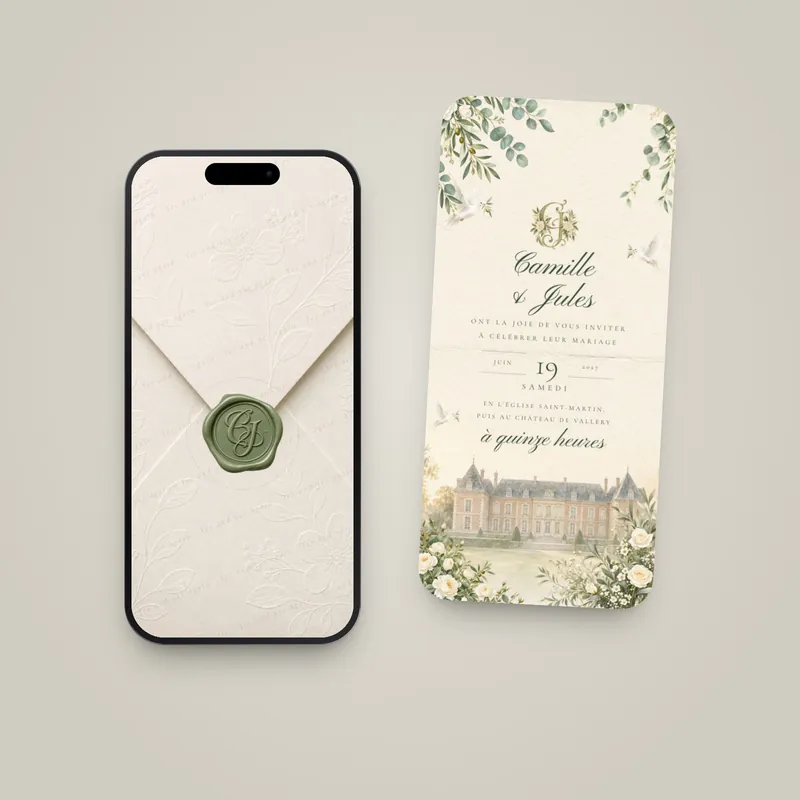
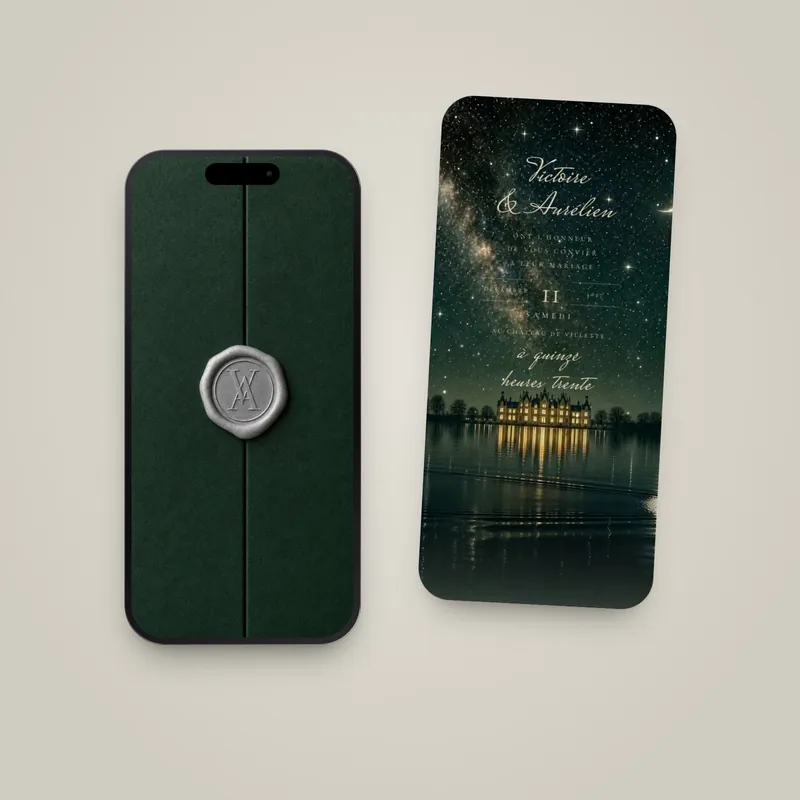
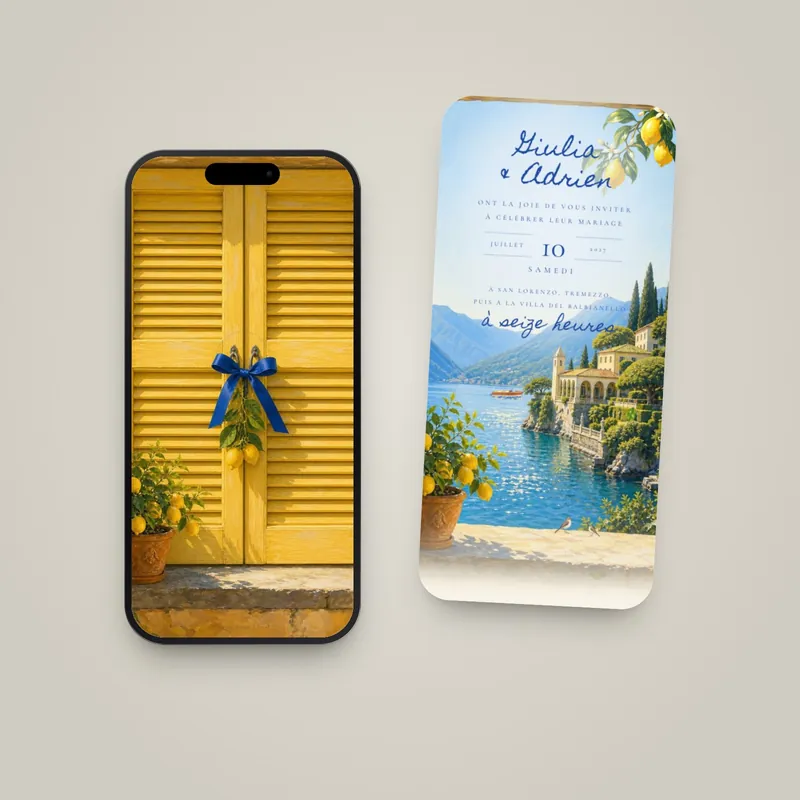
The designs are built around the place: Maison Lumière is a watercolor château in ivory and sage, sealed in wax; Royal opens lacquered doors onto the parterres of Vaux-le-Vicomte; Velvet Hour is green velvet, white flowers and candlelight for an evening wedding; Limoncello opens shutters onto Lake Como. Each carries the schedule, the travel details, the dress code and the RSVP, so the invitation is also where guests reply.
Too early, too late
Too early. Bliss & Bone puts the limit at more than four months before a local wedding: invitations get misplaced, details change, and guests do not act on something that far away. Holding the date early is the save the date's job, not an early invitation's.
Too late. Inside six weeks for a local wedding, send today, set the RSVP deadline at two weeks, and phone the people whose presence matters most. Inside ten weeks with traveling guests, send today and call anyone who still needs to book; a hotel block and the nearest airport in the first message do more than an apology. A digital invitation can be ready in days, which is the main reason to choose one when the calendar is already tight.
Before you send: a checklist
- The date, the venue and the ceremony time are final, and the contracts are signed.
- The guest list is final, including plus-ones and children, and every household has an address, a phone number or an email.
- Save the dates went out on schedule, or you are sending early enough to replace them.
- The RSVP deadline is at least two weeks before your caterer's headcount date and does not fall in a holiday week.
- Lodging and travel information are on the invitation or one tap from it, and guests invited to only some events see only those events.
- You have read the whole invitation once as a guest would, on a phone, and every link works.
When all six are true, send. The exact week matters less than reaching the right people with the right information, early enough for them to say yes.
Frequently asked questions
When do you send wedding invitations after save the dates?
On the normal schedule, 6 to 8 weeks before a local wedding and 10 to 12 weeks when guests travel. The save the date does not move the invitation earlier; it is what allows the invitation to stay at 6 to 8 weeks, because guests already hold the date.
When should I send invitations for an October wedding?
For a wedding in mid-October, between about August 20 and September 3 for local guests, and from late July for guests who travel. Set the RSVP deadline around September 17 to 24. October is peak season in much of the US, so lean early.
When should I send invitations for a December wedding?
Between about October 20 and November 3 for a mid-December wedding, with the RSVP deadline before Thanksgiving. Invitations sent in the last week of November compete with holiday mail and holiday plans, and replies slow down.
When do you send wedding invitations in the UK?
UK guides allow more time than US ones. Papier's guide (updated October 2026) says at least two months by post, and four to six months if no save the date went out; Magpie Wedding suggests sending evening invitations with the day invitations around 12 weeks before, with RSVPs back 6 to 8 weeks before.
When should I send invitations to out-of-town guests?
Ten to twelve weeks before, so they can book flights and hotels at reasonable prices. If most of the list is local, you can send the traveling guests at 12 weeks and everyone else at 8, or simply send the whole list at 12 weeks.
What if I did not send save the dates?
Send the invitation earlier. Bliss & Bone's 2026 timeline says 12 weeks before the wedding when no save the dates went out; 10 weeks is workable for a short, local list. The invitation then does the save the date's job as well as its own.
Is two months too early to send wedding invitations?
No. Eight weeks is the standard upper end for a local wedding, and three months is normal when guests travel. Bliss & Bone's guide puts "too early" for a local wedding at more than four months, when guests misplace invitations and details change.
Is four weeks too late?
It is late, but workable for a local wedding if you send today, set the RSVP deadline at two weeks, and phone the guests who matter most. For a wedding with traveling guests, send now and call anyone who still needs to book.
Do digital wedding invitations change the timeline?
Not the dates guests need, which stay at 6 to 12 weeks. They remove the production time: a printed suite needs to be ordered four to five months before the wedding, while a digital invitation can be ready in days and sent the same day.
Designs in this guide

An invitation that opens on their phone
23 designs, each with its own animated intro and a live demo to open before you order. From $69, one-time payment, built-in RSVP.
Keep reading
Send save the dates 6 to 8 months ahead, or 9 to 12 for a destination wedding. A timeline for every case, with real dates and the digital option.
Guide · 10 min readDestination Wedding Invitation Timeline: Save the Dates to RSVPsWhen to send destination wedding invitations, save the dates and RSVP reminders when guests must book flights and hotels. Dated table and a worked example.
Guide · 9 min readSave the Date vs Wedding Invitation: What Each One Is ForA save the date announces the date; the invitation gives the details and collects RSVPs. When to send each, what to include, and whether you need both.
Guide · 9 min readDestination Wedding Save the Dates: Timing, Wording, ExamplesDestination wedding save the dates go out 9 to 12 months ahead. What to include (travel, hotels, website), wording examples and designs for your venue.