Wedding Invitation Trends for 2027
The trends carrying into 2027 are the ones that stationers and wedding publications documented through 2026: the venue as the subject of the design, editorial typography in place of script, color carried by the stock rather than the ink, layered and sealed pieces that open, and digital invitations with motion, sound and the RSVP built in. What is fading is the generic template, foil on everything, the single-language suite and the invitation that sends guests elsewhere to reply.
Trend articles are usually written in December and forgotten by February. This one is written from what stationery studios and wedding publications actually documented during 2026, with the sources dated, and it will be updated as the year goes on. Where our own designs illustrate a trend, we say so; where a trend belongs to print and has no digital equivalent, we say that too.
How we read the trends
We used four 2026 sources that describe what couples are ordering rather than what writers hope they will: Paperlust's two trend guides (March 27, 2026, updated October 2, and June 2, 2026, updated October 6), StationeryHQ's "10 Best Wedding Invitation Trends of 2026," and 1Invites' "Top Wedding Invitation Trends for 2026" (February 12, 2026). Each is a stationer describing its own order book, a bias worth noting and also the reason the observations are concrete. We have no sales data of our own to add, and we have not invented any.
1. The venue becomes the design
The clearest shift in 2026 was from decoration to place. Paperlust's June guide describes custom illustration moving from a niche luxury to a mainstream expectation, with couples anchoring the design in the facade of their venue or a flower from its garden; its March guide lists venue portraits among the custom illustration requests. StationeryHQ files the same thing under hyper-personalized storytelling.
The reason it holds into 2027 is that a venue does not date. A color trend looks like its year; a villa on a lake looks like your wedding. For a destination wedding, the illustration also does practical work, because guests see where they are going before they book.
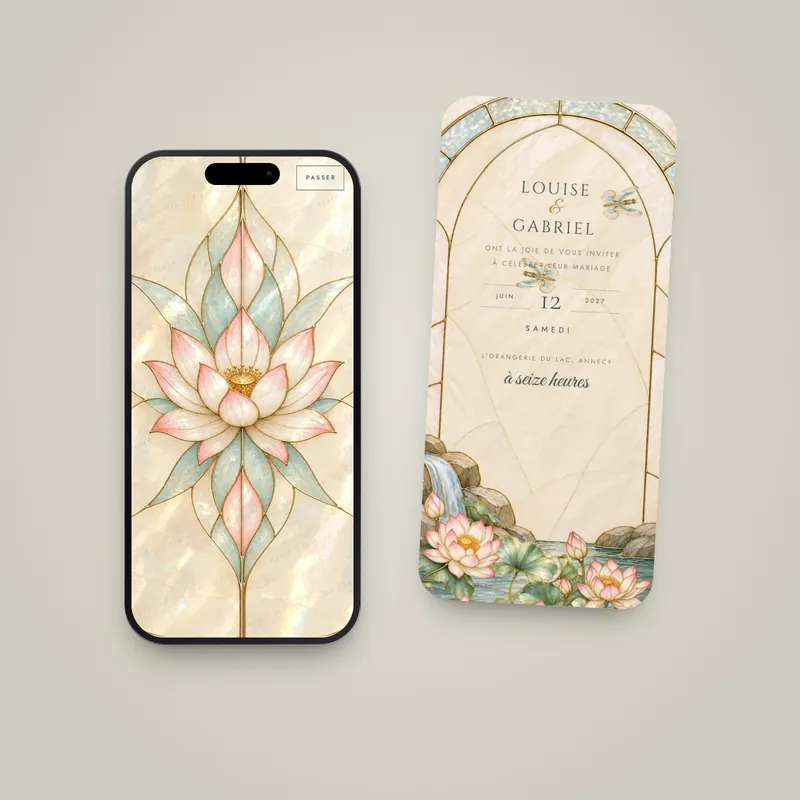
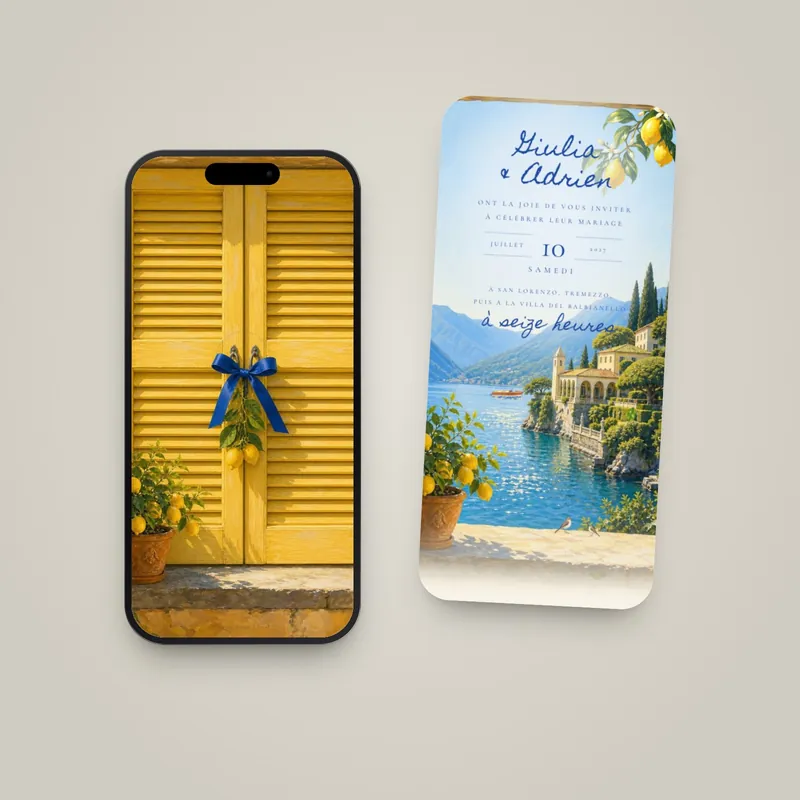
This is the principle our collection is built on. Limoncello opens butter-yellow shutters onto Villa del Balbianello and Lake Como; Celeste sets dragonflies and lotus flowers beside the abbey and the orangery at Annecy; Riviera is Villa Ephrussi at Saint-Jean-Cap-Ferrat; Provence opens blue-gray shutters onto lavender and olive trees. With the Signature plan, the cover is redesigned around your own venue, in the technique of the design, from your photos or the venue's.
2. Editorial typography, and the end of script by default
Both Paperlust guides and StationeryHQ put typography near the top of their lists. StationeryHQ's first trend is magazine-style typographic layouts; Paperlust's June guide describes a clear counter-trend toward clean contemporary serifs after a decade dominated by script, calligraphy and copperplate lettering, and its March guide pairs script names with sans-serif detail in what it calls retro-modern layouts, with an oversized date as the hero.
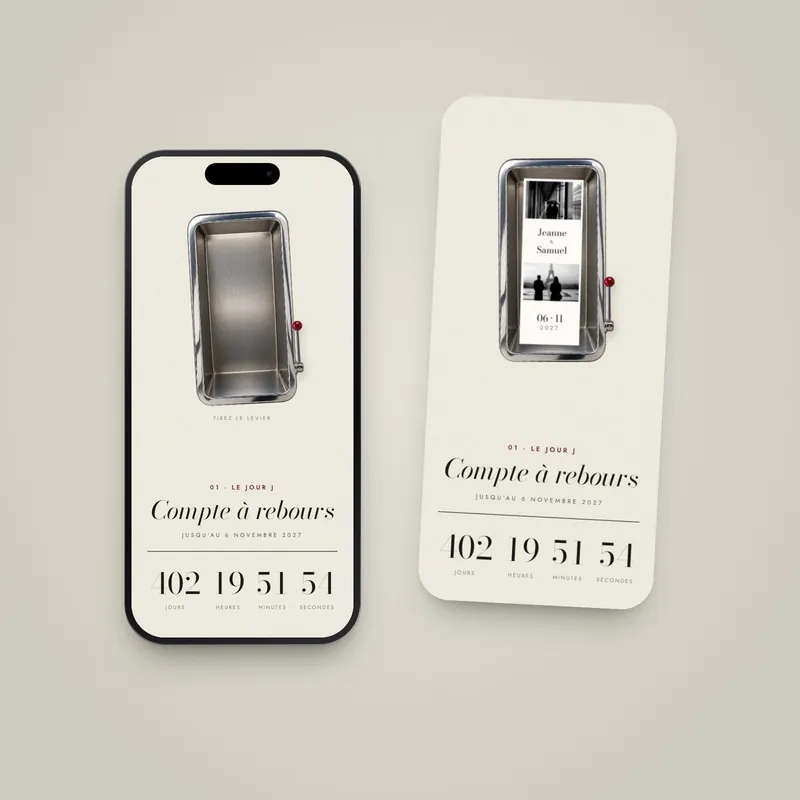
What that means in practice for 2027: one typeface family doing the work, the names or the date set large, and script, if any, used as an accent rather than the whole page. Most of our designs set the names and the date in a Cormorant serif, with a quieter face for the practical details, which is the editorial pairing these guides describe; Paparazzi takes it furthest, with a Bodoni headline on a sealed black-and-white magazine and a single line of bordeaux.
3. Color on the stock, not the ink
The palette news of 2026 was less about new colors than about where the color sits. Paperlust's March guide puts it directly: the color goes on the stock, not the ink. It names burgundy, oxblood, terracotta, sage, dusty rose and matte black cards with white-ink or foil lettering, and extends the same logic to envelopes in rust, sage, oxblood and dusty rose. StationeryHQ makes the envelope its own trend. 1Invites' February guide keeps the seasonal palettes that have held for years: blush, sage and lavender in spring; rust, burgundy and gold in fall; navy, emerald and velvet in winter.
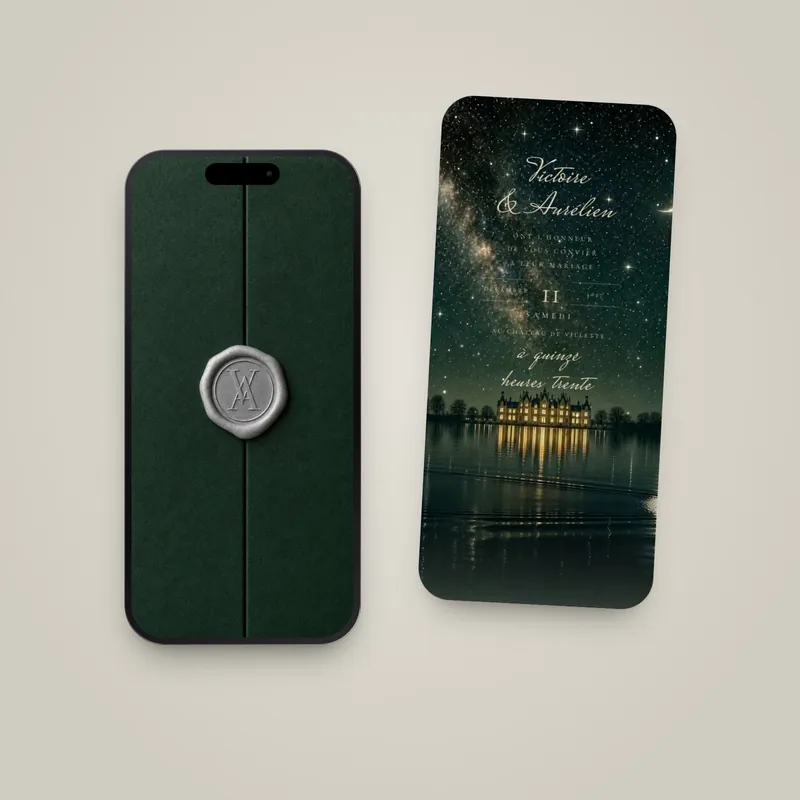
The digital translation is a full-screen field of color with the type reversed out of it. Velvet Hour is green velvet with white flowers, gold and candlelight; Opera is a burgundy velvet curtain with an ink line and gold; the Bordeaux save the date opens a burgundy envelope onto a table set under lanterns. Burgundy Rose takes the softer direction, a blush card sealed in ivory.
Pantone's color for 2027 will be announced in December, after this article is published. We will add it when it exists rather than guess.
4. Layers, seals and pieces that open
Vellum overlays, wax seals and envelopes were the most-cited material trends of 2026. Paperlust's June guide calls vellum a defining material of the season and describes wax seals moving from finishing touch to centerpiece, with custom monogram stamps matched to the typography; StationeryHQ lists vellum layers, tactile paper and the envelope as a main event in its own right. The common thread is sequence: the guest unwraps, unseals, lifts a layer, and only then reads.
A screen cannot be touched the same way, but it can open. Maison Lumière is a card sealed in sage wax that breaks when the guest opens it; Velvet Hour is a sealed pouch; Set Sail opens a brass porthole onto the chapel and the sea; Swan Lake unties a lilac ribbon from an embroidered card; Garden Party swings white gates open onto the bastide. When a design has a seal or a monogram, it carries the couple's initials in the typeface of the design, and a custom monogram can be designed for the opening and the signature.
5. Motion and sound: the cinematic opening
The 2026 guides describe digital invitations in terms of what they can do that paper cannot: 1Invites lists animated and augmented-reality openings, and the broader coverage of the year treats interactive digital invitations as an established category rather than a novelty. The observable trend is not that invitations are digital, which is old news, but that the digital ones are expected to open like a short film: an establishing shot, a movement, a reveal, with music.
Every design in our collection opens with an animated intro before the invitation itself: the curtain of Opera rising on a château, the shutters of Provence opening on lavender, the pearl curtains of Pearl parting on a lakeside belvedere. Each has its own music, played when the guest taps, and the opening leads straight into the schedule, the venue and the RSVP. For 2027, expect the opening to become the part of the invitation couples talk about most, because it is the part guests forward.
6. Multilingual guest lists
1Invites' February 2026 guide notes that multilingual invitations are on the rise, and the growth of destination weddings makes the reason obvious: a wedding at Lake Como with an American couple has Italian relatives, British friends and a French planner on the same list. The 2026 print answer is a second printed card, or an English suite with an apology. The digital answer is a single invitation that each guest reads in their own language.
Our invitations include two languages with the Essential plan, three with Signature and as many as needed with Bespoke, in any language rather than only the languages of our site, and the guest switches with one tap. The RSVP, the schedule and the travel notes are translated with the rest.
7. The RSVP inside the invitation
1Invites records digital RSVPs becoming popular with couples hosting large events or destination weddings, and Bliss & Bone's 2026 timeline recommends a wedding website link on the invitation so guests can find lodging and reply the moment they receive it. The direction for 2027 is to remove the detour altogether: the guest replies on the page they are reading, and the reply lands in the couple's guest list.
That is how ours work. The RSVP is part of the invitation, replies go to one guest list, the seating chart is built from it, and the details on the page can be updated without limit until the day. For couples inviting different groups to different events, a welcome dinner for family and the wedding for everyone, each group gets its own version showing only the events it is invited to. The etiquette rule does not change: a reply still needs a deadline, which our guide on when to send wedding invitations sets at 3 to 4 weeks before a local wedding.
8. Shapes, formats and the phone screen
Paperlust's March guide opens with arch and organic die-cut shapes; StationeryHQ says "the rectangle is officially optional"; Paperlust's June guide adds oversized statement cards, A4 and larger. These are print trends, and they stay in print: a die-cut arch has no digital equivalent worth faking.
The digital format question is different and simpler. The invitation is read on a phone, almost always vertically, so the format that matters is a full-height 9:16 screen with nothing to pinch or rotate. Designs that are built for that screen, rather than a letter-sized page squeezed into it, are the ones that read as 2027 rather than 2017.
9. Sustainability, said plainly
Seed paper, recycled stocks and plant-based inks appear in every 2026 list, and StationeryHQ ranks sustainable, low-waste production among its ten. The honest digital position is that a link uses no paper, no ink and no postage, and that some guests still want something to hold. The guides agree: 1Invites recommends a hybrid, digital for most with paper for key guests. A digital invitation for the list and a few printed cards for grandparents is the version of this trend most couples will actually live with; our comparison of digital vs paper save the dates goes through the trade-offs without pretending either side has no cost.
What is fading
- Foil on everything. Paperlust's June guide contrasts 2026's deliberate, restrained foil, a single monogram or a border, with the maximalism of 2018 and 2019.
- Script as the whole page. The same guide's counter-trend toward contemporary serifs, above.
- The apologetic QR code. Paperlust describes the QR code as having gone from pandemic necessity to designed element, which is to say the small square in the corner with a note explaining it is on its way out, replaced either by a designed code or by a fully digital invitation that needs none.
- The generic template. Not named by any guide as a trend, because it is the thing every trend on this list is moving away from: a layout with the names dropped in, no venue, no opening, no language choice.
- The invitation that sends guests elsewhere. A card that points to a website that points to a form. In 2027 the invitation is the page.
Etiquette in 2027: what does not change
Trends move; the rules underneath them do not. An invitation still needs the hosts, both names, the date written in full, the venue, the time, the dress code and a reply deadline. A save the date still needs "invitation to follow," and still goes only to people who will be invited. A digital invitation adds a few rules of its own, which came out of 2026 practice rather than any guide: send it inside a short personal message rather than as a bare link, send to households one at a time rather than to a group chat, and print or phone for the few guests who do not live on their phones. Our guides on save the date vs wedding invitation and how to send save the dates by text, WhatsApp and email cover both.
How to use a trend without dating your invitation
Paperlust's advice in June 2026 is the sensible one: combine two or three complementary elements rather than a checklist. Applied to 2027, the combinations that hold up are a venue illustration with editorial type; a saturated stock color with a restrained monogram; a cinematic opening with a quiet page behind it. Pick the trend that says something true about your wedding, the place, the season, the languages at the table, and let the rest stay classic. The invitation will look like 2027 in the right way: like the year you were married, not the year of a palette.
Sources, all consulted in October 2026: Paperlust, "Wedding Invitation Trends 2026: Styles Every Couple Is Loving" (March 27, 2026, updated October 2, 2026) and "2026 Wedding Invitation Trends: 10 Stationery Shifts to Watch" (June 2, 2026, updated October 6, 2026); StationeryHQ, "The 10 Best Wedding Invitation Trends of 2026"; 1Invites, "Top Wedding Invitation Trends for 2026" (February 12, 2026); Bliss & Bone, "When to Send Wedding Invitations" (updated July 14, 2026).
Frequently asked questions
What are the wedding invitation trends for 2027?
Based on what stationers and wedding publications documented in 2026, the trends with momentum are custom venue illustration, editorial typography, saturated color on colored stock, layered pieces with vellum and wax seals, and digital invitations with motion and a built-in RSVP. We list the sources and dates in the article.
Are digital wedding invitations a trend or the norm?
Both. The 2026 guides treat digital as a standard option rather than a novelty, often alongside a printed keepsake for a few guests. The trend inside digital is quality: an opening animation, music, an illustrated venue, and an RSVP on the page rather than a link out.
What colors are trending for wedding invitations?
Burgundy, oxblood, terracotta, sage, dusty rose and matte black, often as the color of the card itself with white or metallic lettering, according to Paperlust's March 2026 guide. Seasonal palettes still hold: blush and lavender in spring, rust and burgundy in fall, navy and emerald in winter.
Is calligraphy out of style?
Not out, but no longer the default. Paperlust's June 2026 guide describes a counter-trend toward clean, contemporary serifs after a decade dominated by script. A script name against a serif body is the combination that reads as current.
Are QR codes on wedding invitations still acceptable?
Yes. Stationers now treat the QR code as a designed element rather than an apology: it sits on the details card and points to the wedding website or RSVP page. With a fully digital invitation, the code is unnecessary: the invitation is the link.
What is the Pantone color for 2027?
Pantone announces its color of the year in December, so it is not known as of this writing. We do not guess; we will update this page when it is published.
Should the save the date follow the same trend as the invitation?
It should share the palette and the typography, so guests recognize the second message when it arrives. It does not need the same format: a digital save the date and a printed invitation, or the reverse, is common.
Designs in this guide
An invitation that opens on their phone
23 designs, each with its own animated intro and a live demo to open before you order. From $69, one-time payment, built-in RSVP.
Keep reading
A save the date announces the date; the invitation gives the details and collects RSVPs. When to send each, what to include, and whether you need both.
Guide · 15 min readWhen to Send Wedding Invitations: The Complete TimelineSend wedding invitations 6 to 8 weeks before the day, earlier for out-of-town guests. Month-by-month table, UK and destination rules, worked dates.
Guide · 6 min readDigital vs. paper save the dates: which one fits your weddingDigital vs. paper save the dates: cost, timing, etiquette and which guests still need a card. A side-by-side table and the mixed approach many couples use.
Guide · 6 min readHow to send save the dates by text, WhatsApp and emailHow to send a digital save the date by text, WhatsApp or email: individual or group, broadcast lists, link previews, avoiding spam, and messages to copy.